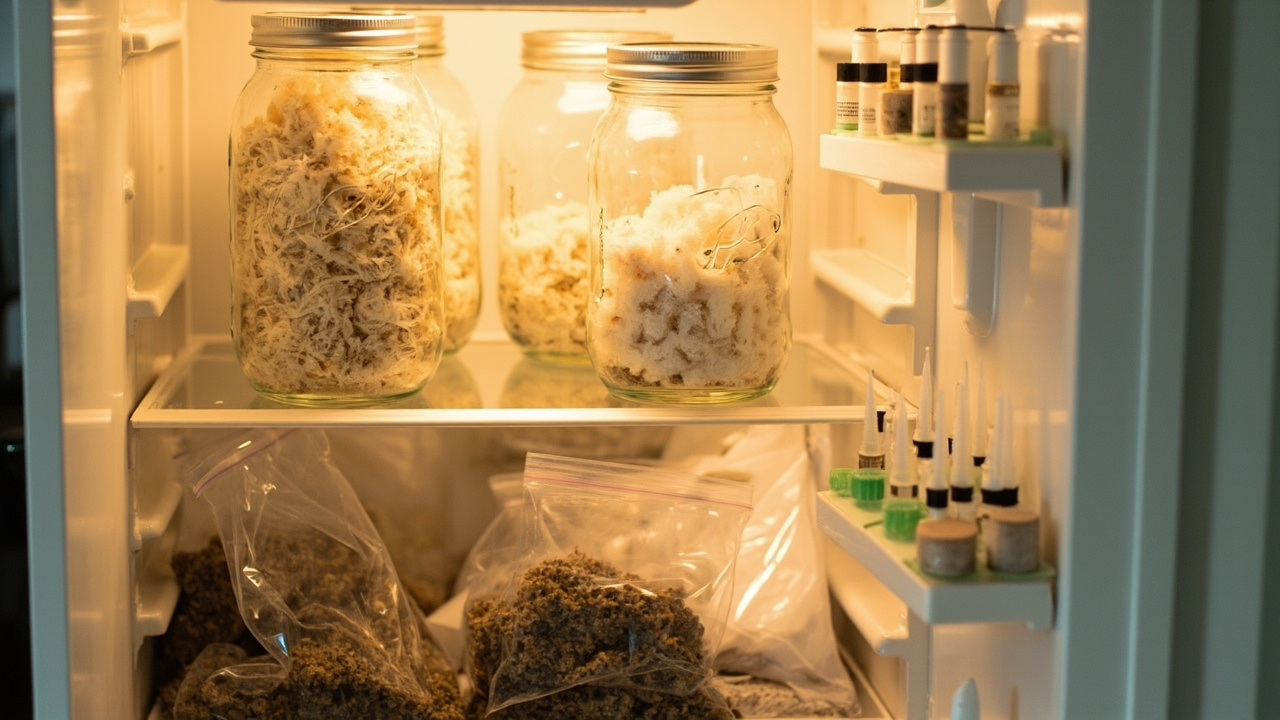
You bought gourmet spawn for oyster, lion’s mane, or shiitake — but you’re not ready to inoculate yet. Maybe your grow bags haven’t arrived, or you have leftover grain spawn after a batch. Spawn is living tissue. Left at room temperature, it slowly eats through its grain reserve, loses vigor, and opens the door to contamination. A standard kitchen fridge at 35–40°F puts that metabolism on pause. This guide covers how to store every gourmet spawn format — grain, plug, sawdust, and liquid culture — with labeling, shelf life, contamination checks, and a revival protocol for waking refrigerated spawn before use.
Quick answer
Mushroom spawn stays viable longest at 35–40°F in a standard kitchen fridge. Grain spawn lasts 2–6 months in sealed jars, plug and sawdust spawn hold 6–12 months, and liquid culture keeps 12+ months in sterile syringes. Label every container with species, date, and format. Check weekly for wet spots, sour smells, or green patches. To revive, let refrigerated spawn reach room temperature 24 hours before inoculating fresh substrate.
What this is — and what it is not
What this IS
Storing viable gourmet mushroom spawn — grain spawn, plug spawn, sawdust spawn, and liquid culture — between grows in a home kitchen. No lab cold room required. A standard refrigerator does the job if you manage temperature, labeling, and contamination checks.
Not spore storage
Spore prints and spore syringes are for long-term genetics banking. They have a different viability window (1–2+ years) and storage logic. This guide covers living mycelium on a food source, not dormant spores.
Not agar or culture maintenance
Petri dish slants in the fridge are short-term culture maintenance (2–4 weeks). That’s covered in agar plate preparation. Spawn storage is about keeping bulk inoculum — grain, dowels, sawdust, or LC — ready for your next substrate batch.
Not actives or psychedelic storage
This guide covers gourmet and edible species only — oyster, lion’s mane, shiitake, king oyster, pioppino, and reishi. If you’re growing other types of mushrooms, consult specialty resources outside our kitchen-growing scope.
Why spawn storage matters
Spawn is mycelium growing on a food source — rye grain, hardwood sawdust, or wooden dowels. Even at fridge temperature, the mycelium keeps metabolizing, slowly consuming its food reserve. The colder the storage, the slower that consumption.
Poor storage does two things. First, the mycelium burns through its grain reserve and loses vigor — by the time you inoculate, colonization is slow and patchy. Second, warm or contaminated storage invites competitors. A jar that sat at room temperature for two weeks may look fine but carry bacterial wet-spot or mold spores that bloom once you open it.
Good storage extends shelf life 2–10× compared to room temperature. Grain spawn that lasts 2–4 weeks on a counter holds 2–6 months in a fridge. That difference matters when you’re sequencing grows across a season.
What you’ll need
| Role | Product | Why |
|---|---|---|
| Temperature check | Fridge thermometer | Verify 35–40°F, not warmer |
| Grain containers | Wide mouth mason jars | Glass, airtight, dishwasher-safe |
| Bag sealing | Vacuum sealer bags | Remove air from spawn bags |
| LC storage | Sterile 10ml syringes | Store LC in individual doses |
| Culture sealing | Parafilm M | Seal jar lids and plate edges |
You don’t need all five products for every format. If you only store grain spawn in jars, you need jars, a thermometer, and optionally Parafilm. Vacuum bags and syringes come into play for sawdust spawn and liquid culture respectively.
Spawn formats: shelf life at a glance
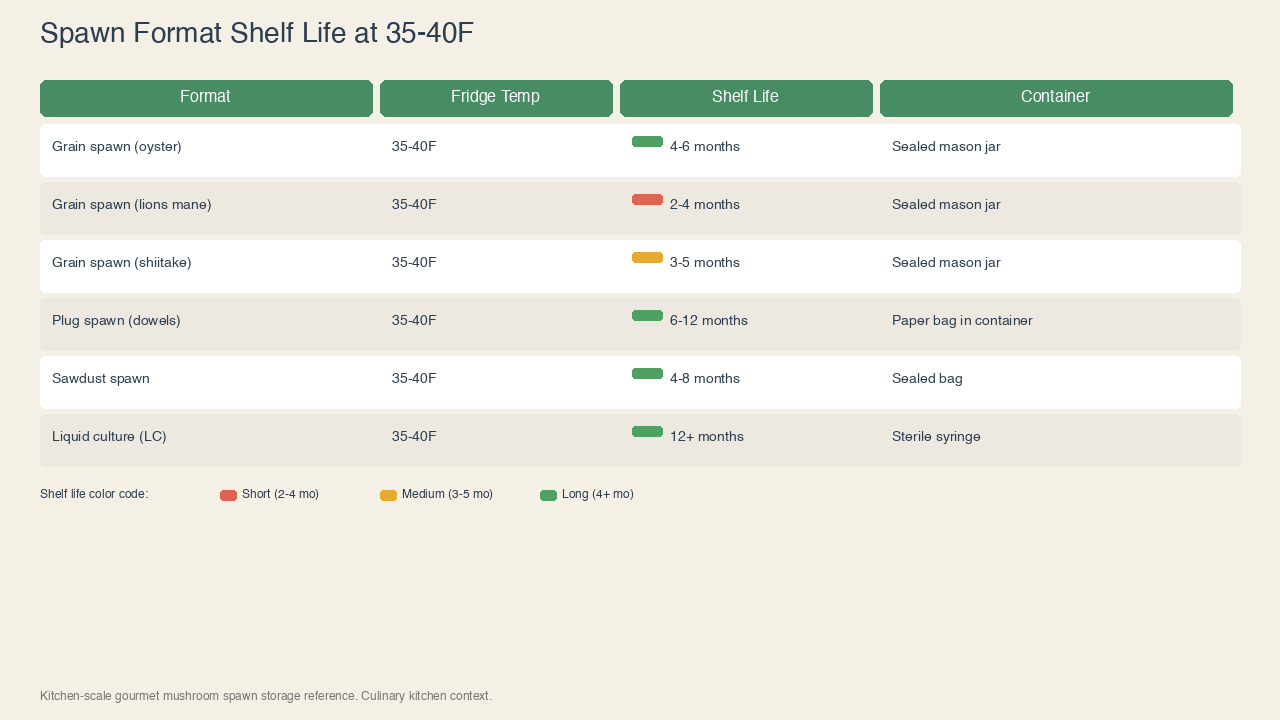
Different spawn formats have different shelf lives because the substrate (food source) degrades at different rates. Grain is nutrient-dense and metabolically active — shortest shelf life. Plug dowels are hardwood, which resists degradation — longest. Liquid culture has minimal nutrient content in the broth, so the mycelium stays dormant longer.
| Format | Fridge temp | Shelf life | Container |
|---|---|---|---|
| Grain spawn (oyster) | 35–40°F | 4–6 months | Sealed mason jar |
| Grain spawn (lion’s mane) | 35–40°F | 2–4 months | Sealed mason jar |
| Grain spawn (shiitake) | 35–40°F | 3–5 months | Sealed mason jar |
| Plug spawn (dowels) | 35–40°F | 6–12 months | Paper bag in container |
| Sawdust spawn | 35–40°F | 4–8 months | Sealed bag |
| Liquid culture (LC) | 35–40°F | 12+ months | Sterile syringe |
Oyster is the most resilient species — its mycelium tolerates cold storage well. Lion’s mane and pioppino are more sensitive; expect 2–4 months before viability drops. Shiitake sits in the middle at 3–5 months.
Species temperature tolerance and shelf-life matrix
Mushroom spawn storage also varies by species. Producers publish conservative use-by windows: North Spore caps grain spawn at 4 months on every species page, and Field & Forest recommends 34–42°F with grain held to 3 months or less. Plan by the published window; the format table above is the kitchen bandwidth.
| Species | Producer window (grain, refrigerated) | Tolerance and handling | Revival speed |
|---|---|---|---|
| Oyster grain spawn storage | up to 4 months; 6–8 weeks reliably (NL) | toughest of the six; ropey mycelium clumps, break up weekly | fastest: white edges within 24 hours |
| Storing lion’s mane spawn | up to 4 months; 2–3 months (NL) | most temperature-sensitive; back shelf, never the door | gentle: wispy mycelium, judge after 24 hours |
| Shiitake spawn storage | up to 4 months; 2–3 months (NL) | brown metabolite liquid is normal stress, not contamination | steady: slow to recover, don’t judge on day 1 |
| King oyster spawn fridge life | up to 4 months | prefers cool; dries or stalls when humidity slips | recovers at the cool end of room temperature |
| Pioppino spawn storage | up to 4 months | fast colonizer, finicky; likes cool, dries easily | bounces back fast once warmed |
| Reishi spawn keeps longest | up to 4 months; 3–4 months (NL) | one of the hardiest for long-term storage; thick lacquered mycelium | slow but reliable, slow is not dead |
NL = NatureLion shelf-life data.
When you store grain spawn in the fridge, confirm the band with a fridge thermometer; oyster mats fastest, so shake the jar weekly. Not every edible species chills: Field & Forest warns that pink oyster and almond agaricus spawn cannot be refrigerated at all, so these six are the cold-adapted kind. The revival protocol below covers all six.
Step-by-step: storing grain spawn
Step 1 — Inspect before storing
Check the jar or bag for contamination before it goes in the fridge. Don’t store contaminated spawn — cold storage slows mold but doesn’t kill it. If you see green patches, wet spots, or smell anything sour, toss it now instead of letting it spread to your other stored cultures. See the contamination overview for a full diagnostic chart.
Step 2 — Label with species, date, and format
Use masking tape or a label maker. Write: species name, spawn format (grain/LC/plug), date stored, and expected expiry. Unlabeled jars are how growers end up inoculating lion’s mane substrate with six-month-old oyster spawn. Label before the jar goes in — not “later.”
Step 3 — Seal the container
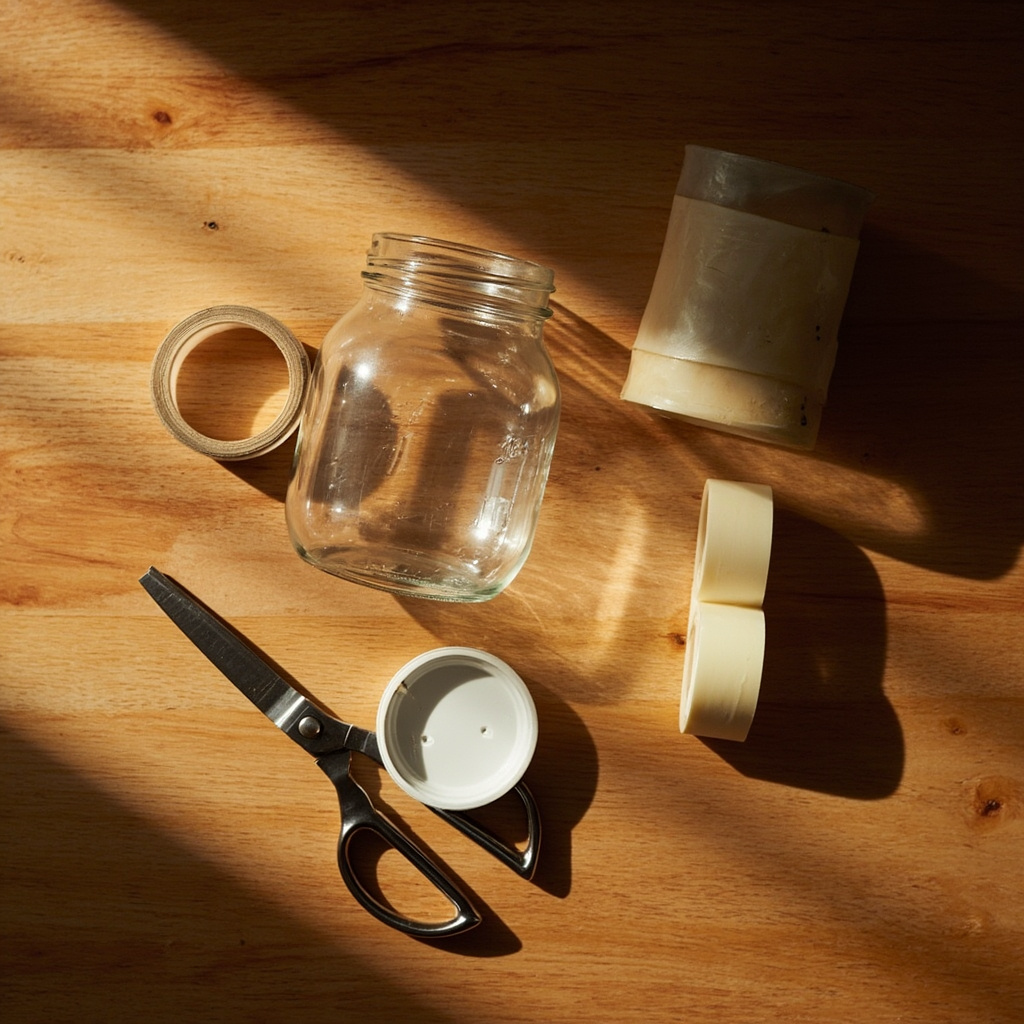
For jars: screw the lid tight. For extra protection against contamination, wrap the lid edge with Parafilm M — the self-sealing film clings around irregular shapes and blocks airborne spores while allowing slight gas exchange. For bags: fold the filter patch flat and clip it shut, or vacuum-seal using sealer bags if your bag design allows it.
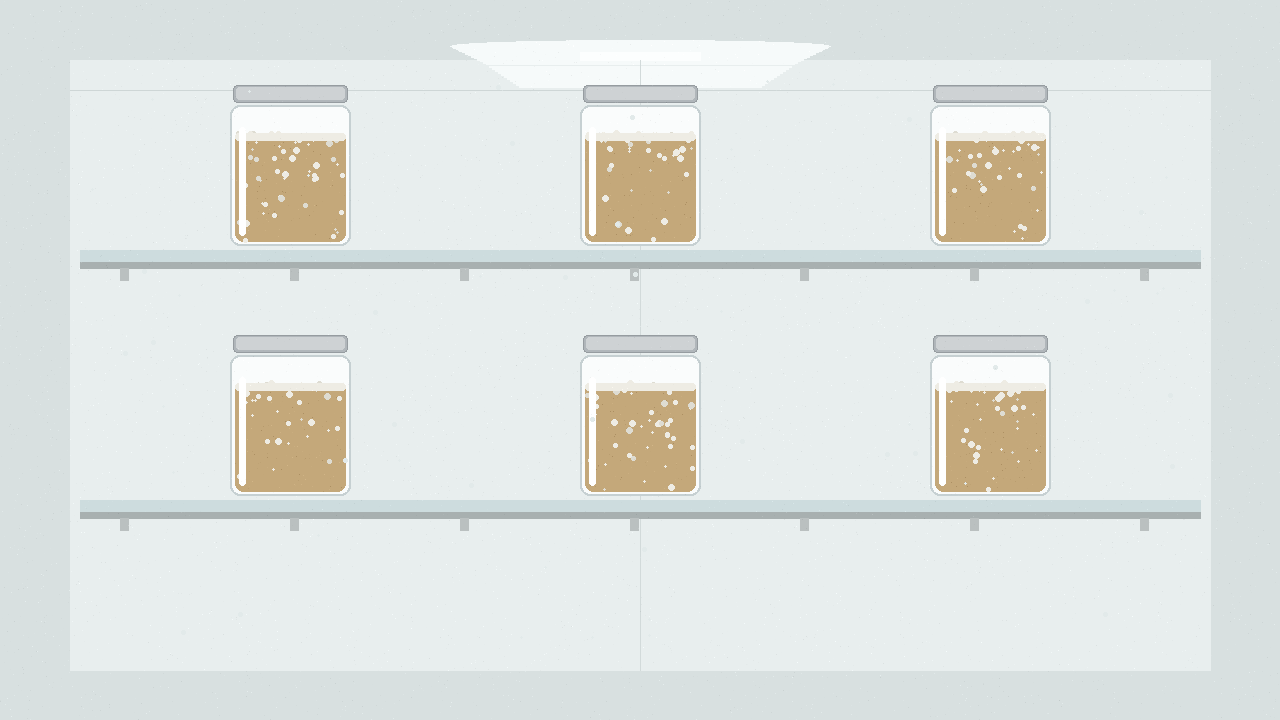
Step 4 — Place in fridge at 35–40°F
Middle or lower shelf, not the door. The door swings open and shut, causing temperature swings that stress mycelium. Verify the actual temperature with a fridge thermometer — many fridges run 4–5°F warmer than their dial setting. Target 2–4°C (35–40°F).
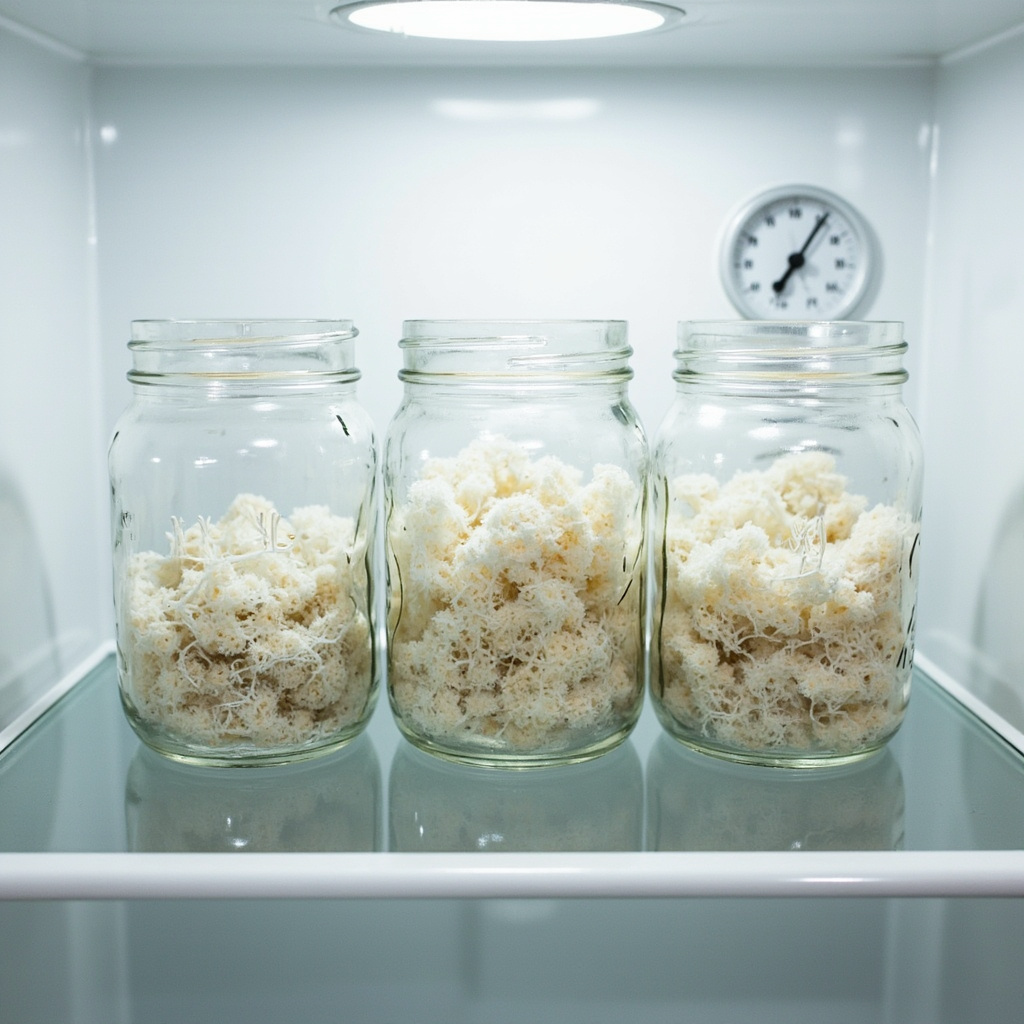
Step 5 — Check weekly for contamination
Look for three signs: wet spots or liquid pooling at the bottom (bacterial contamination), sour or rancid smell, and green/blue patches (Trichoderma or Penicillium mold). If you spot any, discard immediately — don’t try to salvage it. See green mold / Trichoderma for identification help.
Storing plug and sawdust spawn
Plug spawn (dowels)
Plug spawn is hardwood dowels colonized with mycelium. It’s more resilient than grain — 6–12 months in the fridge is typical. Keep plug spawn in its original bag, or transfer to a paper bag inside a sealed container. Don’t vacuum-seal plug spawn; the dowels need slight gas exchange to stay alive.
Sawdust spawn
Sawdust spawn works similarly to grain spawn but on a coarser substrate. Seal the bag with the filter patch accessible for gas exchange. Shelf life runs 4–8 months. Watch for bacterial wet-spot more carefully — sawdust holds more moisture than grain, which means a bigger window for bacteria if the bag wasn’t sealed properly. If you’re storing sawdust spawn long-term, vacuum sealer bags can remove excess air and extend shelf life by reducing the oxygen that fuels microbial competitors.
Step-by-step: storing liquid culture
Step 1 — Draw into sterile syringes
Pull your liquid culture into individual 10ml sterile syringes in front of a still-air box or flow hood. Cap each syringe immediately. This step keeps each dose sealed and separate — if one syringe goes bad, you don’t lose the whole batch. For the full LC creation process (recipes, sterilization, inoculation), see how to make liquid culture.
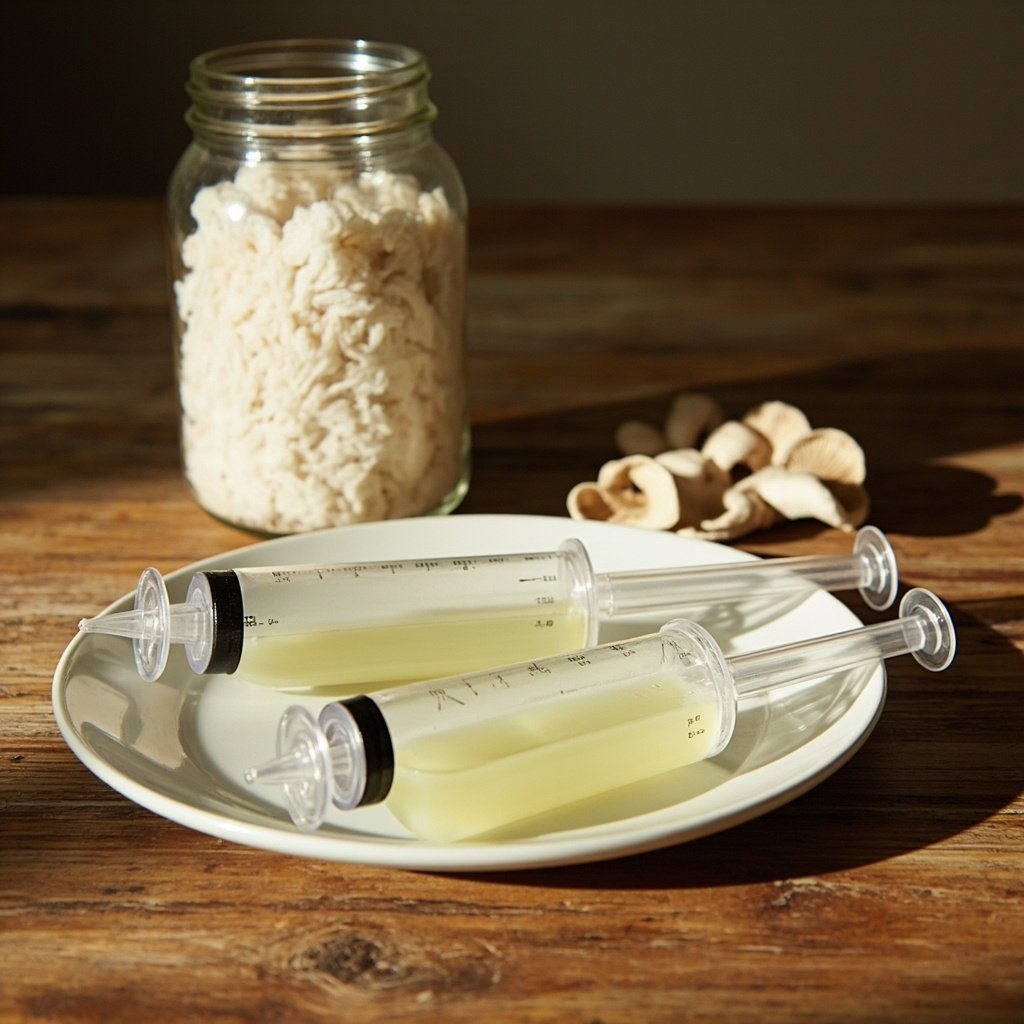
Step 2 — Label each syringe
Same labeling discipline as grain spawn: species, date, format (“LC”), and expected expiry. LC shelf life is 12+ months, sometimes 18–24 months for resilient species like oyster. Write the date so you know which syringes to use first.
Step 3 — Store syringes upright in fridge
35–40°F, upright in a rack or container. Don’t freeze — ice crystals rupture mycelial cells, and LC is no exception. Store syringes away from the back wall where temperatures can dip below freezing in some fridge models.
Beyond 12 months: agar slant long-term archive
Liquid culture rides longest of the four formats here — the 10ml sterile syringes from your LC workflow hold roughly a year in a kitchen fridge, depending on the species and the broth. That’s the practical ceiling of mushroom liquid culture storage. Want to keep a favorite gourmet strain past that mark? The next step up is the agar slant.
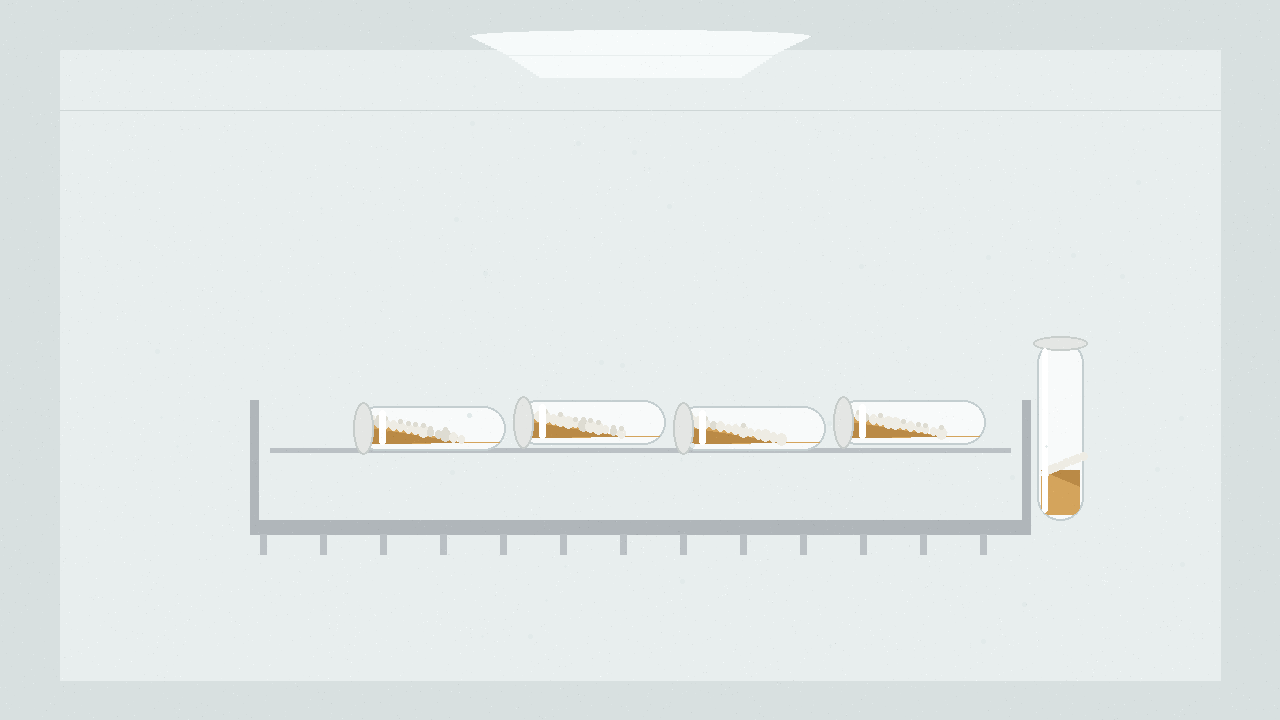
A slant is a test tube of agar poured at an angle — a small-volume master culture with less food and slower metabolism. Pour the agar slanted, inoculate, seal the tube with Parafilm M, the same roll you use on jar lids, and stand it upright at 2–4°C. The full workflow lives in agar plate preparation.
NatureLion’s rule for cultures needed past 3 months: keep them on agar, transferred to fresh media every 2–3 months. Slants stretch that cycle from the 2–4 weeks plates hold to a quarterly rhythm — the biggest mushroom spawn shelf life gain without new gear. Past that, labs freeze cultures in 10–15% glycerol at -20°C or -80°C; that’s outside kitchen scope and stays a footnote here.
Revival after cold storage
Why revival matters
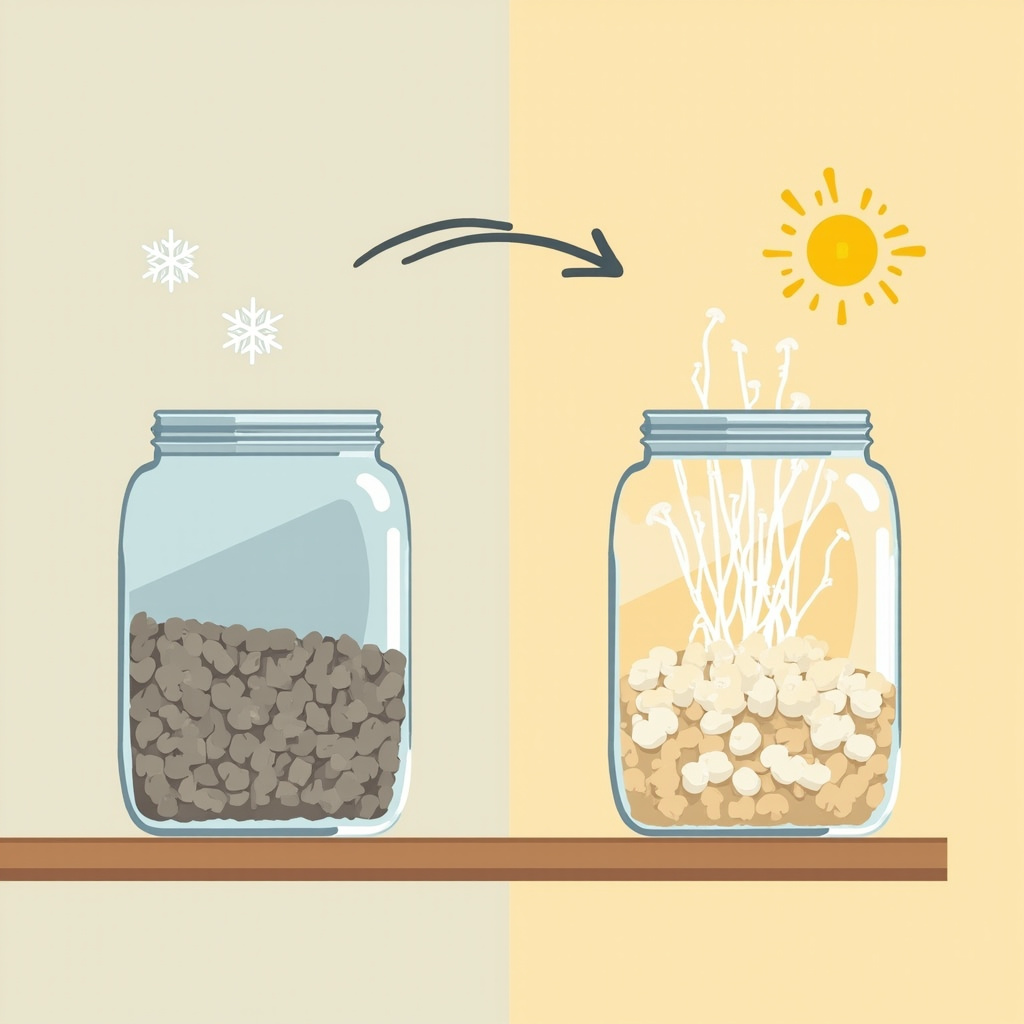
Refrigerated mycelium is dormant and sluggish. If you inoculate substrate with cold spawn straight from the fridge, colonization starts slow and uneven — and that slow start widens the window for contamination to take hold. Reviving spawn at room temperature for 12–24 hours before use wakes up the mycelium and gives it a head start.
Step 1 — Remove from fridge 12–24 hours before use
Let the container reach room temperature (68–75°F / 20–24°C). Don’t rush this by putting the jar near a heater or in warm water — gradual warming is better for mycelial recovery.
Step 2 — Smell test
Open the container and sniff. Healthy grain spawn smells like fresh mushrooms or slightly yeasty bread. Sour, rancid, or gym-sock smell means bacterial contamination — discard the entire container.
Step 3 — Visual check for mycelial recovery
After 12–24 hours at room temperature, healthy mycelium often shows fresh white growth at the edges of the grain. This is the mycelium waking up and starting to colonize again. If the spawn stays grey or brown with no new white growth, viability is low — it may still work but expect slower colonization.
Step 4 — Inoculate fresh substrate
Use revived spawn to inoculate grow bags or new grain jars. Don’t let revived spawn sit at room temperature for more than 48 hours without inoculating — the longer it sits warm, the more the mycelium consumes its grain reserve and the higher the contamination risk.
Decision tree: keep, revive, or discard
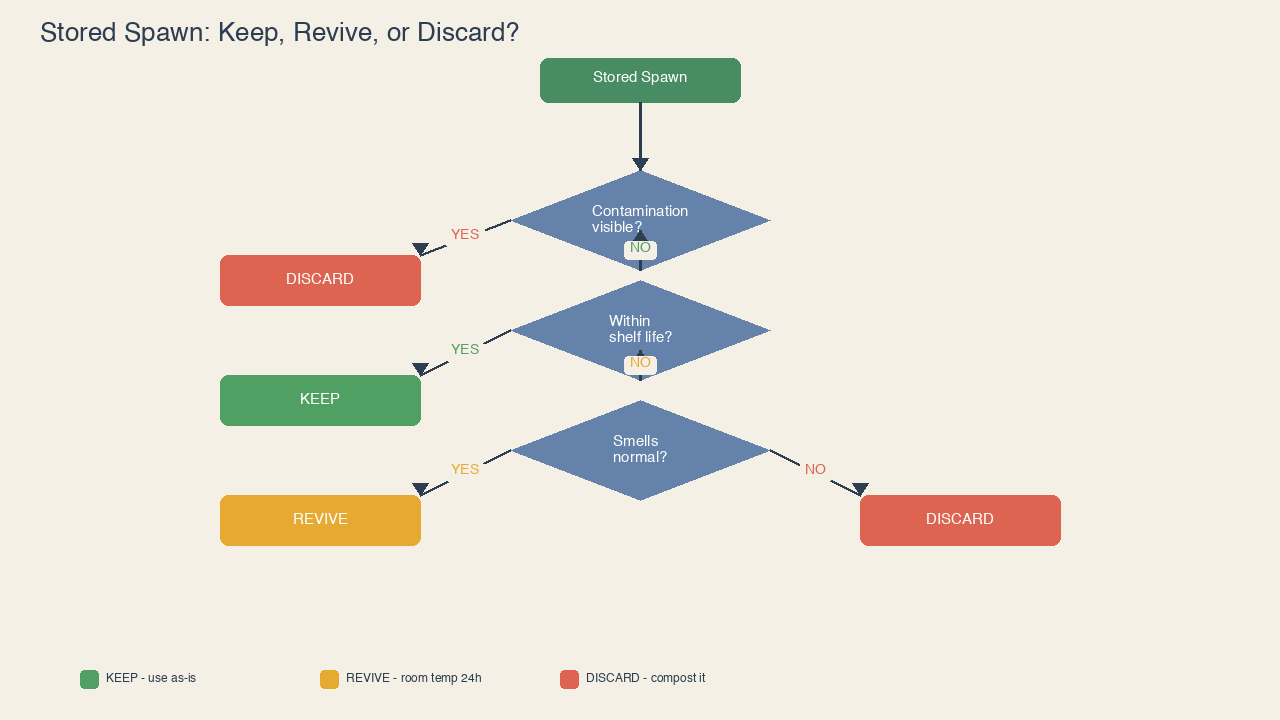
Before using stored spawn, run it through this decision framework.
| Condition | Action | Why |
|---|---|---|
| Within shelf life, no contamination signs | KEEP — use as-is | Mycelium is viable and clean |
| Within shelf life, stored unrefrigerated for 2+ weeks | CHECK — smell test + visual inspection | May have picked up contamination |
| Past shelf life, no contamination visible | REVIVE — room temp 24h, then smell test | May work, but expect slower colonization |
| Green or blue-green patches on grain | DISCARD — green mold / Trichoderma | Mold won’t improve; spreads to fresh substrate |
| Wet spots or bacterial sour smell | DISCARD — bacterial contamination | Bacillus spreads fast in fresh grain |
| Shriveled, dry, or crumbly grain | DISCARD — spawn desiccated | Mycelium has died; no recovery possible |
Common mistakes
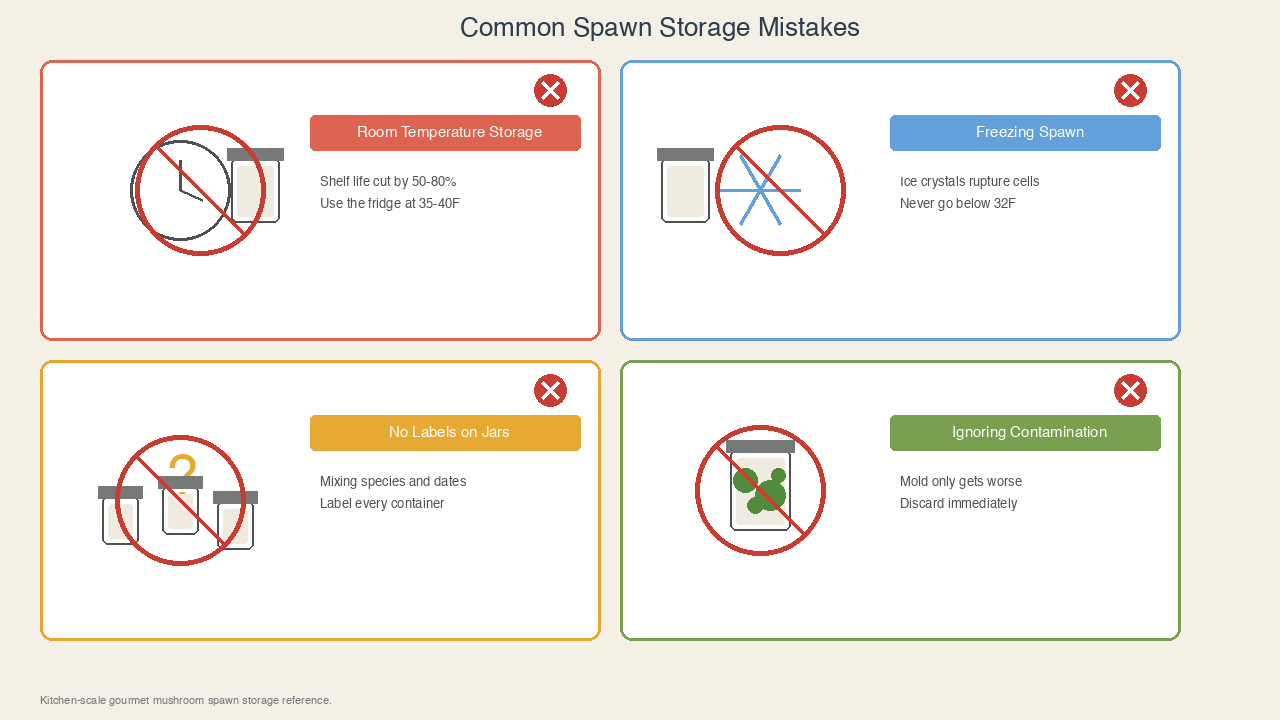
- Storing spawn at room temperature. Cuts shelf life by 50–80%. Grain spawn lasts 2–6 months refrigerated vs 2–4 weeks at room temp. If you don’t have fridge space, you don’t have spawn storage — plan your grows to use spawn within weeks of purchase.
- Freezing spawn to “extend” shelf life. Ice crystals rupture mycelial cell walls, killing the culture. A fridge at 35–40°F is cold enough. Don’t go colder.
- Not labeling containers. Leads to using dead spawn or mixing up species. Label every mason jar before it goes in the fridge — species, date, and format.
- Storing contaminated spawn to “see if it recovers.” Contamination only gets worse in cold storage. Cold slows mold but doesn’t reverse it. Discard immediately.
- Opening the fridge every few hours to check on it. Temperature fluctuations from frequent opening stress mycelium and accelerate viability loss. Check once a week — that’s enough to catch problems early.
Key takeaways
- Store all gourmet spawn formats at 35–40°F (2–4°C) in a standard kitchen fridge
- Label every container with species, date, and spawn format before storing
- Grain spawn: 2–6 months. Plug spawn: 6–12 months. LC: 12+ months
- Check weekly for wet spots, sour smells, and green or blue patches
- Revive refrigerated spawn at room temperature for 12–24 hours before inoculating
- Discard any spawn showing contamination signs — cold storage slows mold but doesn’t fix it
- Use a fridge thermometer to verify actual temperature, not just the dial setting
Related
- How to make liquid culture — LC creation and propagation (this guide covers LC storage)
- Grow bags — What you’ll inoculate with your stored spawn
- Grow kits — Kit workflow context (spawn storage is the pre-use stage)
- Fruiting conditions — Once spawn is ready, move to the fruiting stage